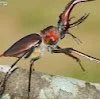
Orchid Mantis…Vest?
Probably one of my most requested creatures: the orchid mantis. I ran into the perfect yarn for this one on a rainy January in Pacific Grove, CA. I always like it when the colors I can use in my knitting represent the creatures in some way (hence my blue-blooded horseshoe crab sweater), and this delicate pink with flecks of yellow and mauve from Farmers Daughters Fibers just SCREAMED “Meredith please turn me into an orchid mantis!”. When yarn screams at you, you are sort of morally obligated to do something about it I suppose.
Yarn secured. Honestly one of my biggest hurdles, as I am primarily inspired by fiber- so just touching or seeing the right yarn can kickstart a vision. But for the orchid mantis…no vision. Worrying. So it came back to Arizona with me and sat in my closet for a while until I grit my teeth and sat down to make an orchid mantis chart.
Orchid mantises**, despite being one of the internet’s favorite insects, are not immediately recognizable (especially when represented by a bunch of smooshy pixels) so I knew the chart had to be fairly large and detailed. There’s a sort of colorwork tradeoff between large and small charts in terms of ease- smaller charts are often easy to design for stranded knitting, and don’t require any ladderback jacquard or intarsia. I love intarsia, but many of my knitters are somewhat purl-averse, so I’ve kept it stranded in the round so far.
The chart was terrifically easy- a few issues with leg placement, but I had finished it in under an hour. Unfortunately, I still had no idea what it would adorn. When I’d bought the yarn I had pictured all-over colorwork, repeating orchids, mantids hidden among them, total colorwork decadence…but staring at this chart I realized that my recognizability problem would only increase with additional elements. Stumped again.
You know when you just want to knit something but you don’t know what? Restless and uninspired you just cast something on to cast something on? That’s exactly what I did next. Whenever I don’t have a WIP I’m always a little itchy, so I wrote out a large and rather ugly orchid chart, then cast on and went forth to make a rectangle. ½ of a popover. The idea here (pictured again below) was to create an asymmetrical popover with mismatched orchid+mantis elements- the orchid on the back and the mantis on the front.
I hated it.
First reason: the orchid chart is ugly. It just is. And there’s absolutely no visual similarity between the orchid and the mantis, so if I were to use this piece to explain mimicry, the unlucky soul on the other end of my explanation would have to nod politely and shuffle away, unconvinced.
Second reason: who even really wears popovers? Besides me…sometimes. They’re cute, but I don’t think they really appeal to the audience clamoring for a mantis pattern- that audience is geared intensely towards sweatervests.
However, there is learning even in failure, and I learned that I really liked the idea of orchids on one side, mantis on another. I don’t really know what exactly inspired this, but I decided to try out another element of asymmetry: small repeating orchids on the back, large mantis on the front. The way I really know when a pattern is “working” is when I cannot put it down, and that was exactly the case this time around. From the first row of orchids I was hooked, and everything just worked perfectly (for the most part) from there on out…with a couple of notable exceptions.
The first problem, was that the yarn is superwash. Which means that for a pattern with different colorwork pieces on the front and the back, I had a few different paths. I started knitting flat, with a half twisted rib (my favorite kind of rib), then took the plunge and joined in the round with a seven stitch steek panel so that I could blow through the back panel- and blow I did, finishing it in under a week. But with superwash yarn, steeking is rarely recommended, as the fibers are much more slippery and do not felt or respond to crochet reinforcement the way of non-superwash fibers.
Luckily for me, I was armed with the sort of confidence that would land me a brutal afterlife in Greek mythology and Liquid Stitchfix. I truly believe that there is not a knitting problem in this world I could not fix with Liquid Stitchfix.
My number 1 piece of advice for steeking anything (regardless of whether you are using some proper, nice technique- or bullshitting through it, as is my custom) is that you cannot, under any circumstance, let your knitting know that you are afraid of it. Steeks can smell fear.
Armed with bravado and glue, I attacked my steek, slathering on a healthy layer of stitchfix to either side of two crochet reinforcements, before letting it dry most of the way, and then using some rather dull kitchen scissors to hack through the center.
You’re probably hoping it didn’t work- and I bet I can picture the look of horror on your face. I have found that knitters are often very precious about technique- my philosophy is that if you can do something correctly and perfectly, it is your solemn duty to do that same thing as strangely and as wrong as you possibly can. It is the most exciting way to learn.
Now that the back panel was sorted and drying on my clothesline, I began working on the front panel. I began with the same twisted rib, a few rows of stockinette, and then added in my contrast color to begin the mantis. Back to my philosophy about doing things badly- I couldn’t be bothered to work with 50 strands of yarn for the intarsia, and once I had the legs finished and began the abdomen, I just used two yarn cakes (the mc and the cc) and did some sort of combination intarsia/stranded nonsense. It worked great, thanks for asking.
The second problem came in making the pattern easily modifiable. In my old age (26) I have become staunchly opinionated on the subject of bust shaping, and I tried out a couple of different necklines for this. The first was true to sweatervest form, a deep v with skinnier straps and some german short rows around the bust. It was fine, it worked, I didn’t love it. The second kept wider straps- bordering on sleeve territory- with a quick rate of decrease at the armpits and a vertical bust dart. A conundrum presented itself: I loved the sleeve shape, but the vertical bust darts (when combined with thicker sleeves) were now totally unnecessary. Alright, frogged again, I reknit it and eliminated the vertical bust darts but kept the drop-shoulder and shallow neckline. Perfect. The quick increases help eliminate excess fabric by the underarm, and there’s enough room for twisted rib.
When I had finished front and back, I moved to seaming. Laying the pieces next to each other, I used kitchener stitch to graft the shoulders on front and back together, and safety pinned the sides to assess the fit. Fit was fine, but (difficult to satisfy) I didn’t love the discontinuity between the panels. It needed a transition. I had quite a bit of my main color leftover, and I finished two twisted-rib side panels during dinner with friends that evening.
I love side panels, really, truly I do. I seamed one panel in, and immediately recognized a solution to a problem I hadn’t even noticed: adding some twisted rib between front and back gave me some lovely continuity between the twisted rib of the hem and the twisted rib applied to the sleeves and neckline. Very satisfying, and solved my additional ease issue- I could just incorporate gussets into the side panel.
Recently my friend Blue told me that superwash yarn is supposed to be put in the dryer. After blocking and partially drying in the Arizona sun, the orchid mantis was looking a little pathetic, so I very carefully and gently put the piece into a silk pillowcase and put it in my dryer for a low-heat, gentle spin. 30 minutes later, no change. Ok, back in the silk pillowcase for a medium-heat, gentle spin. Another 30 minutes, no change.
Ok, no pillowcase, high heat, 1 hour. I don’t know if you are getting this, but I’m not very patient. At the end of the hour, I pulled it out and…perfect. Well, now I know for next time. Unfortunately I have a large quantity of superwash yarn in my stash that I am trying to work through this year. I used to like it, then I knit with non-superwash for almost a straight year…and my taste for superwash has been eradicated.
Thus concludes the tale of orchid mantis construction. I’m currently working my way through chart modifications for smaller and larger sizes, and will hopefully be writing it up in the coming weeks. Easily one of my favorite pieces to-date, and a total compliment-magnet.
Bugs&Kisses
leafhopper